Machine learning explained with gifs: style transfer
About style transfer
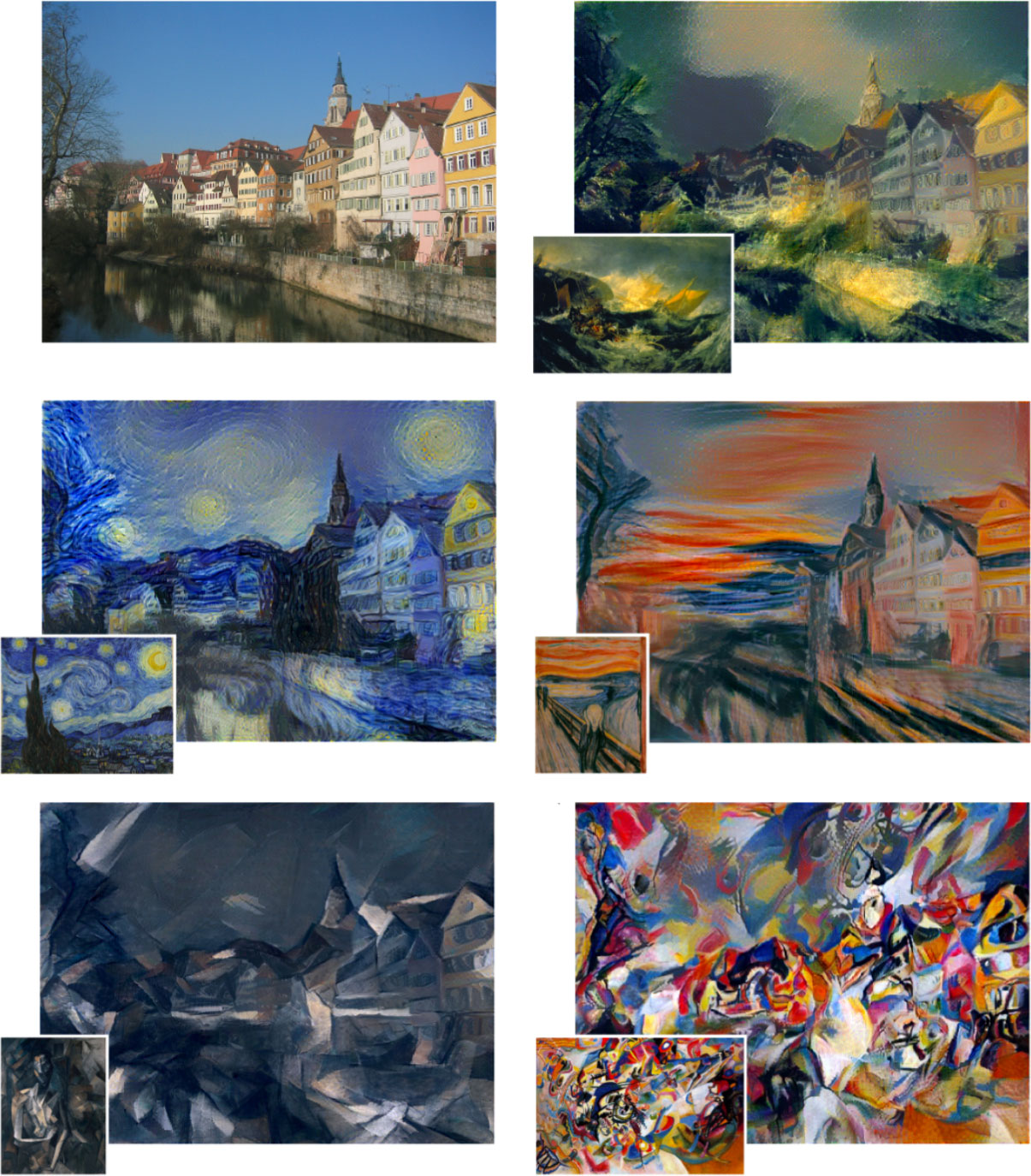
Pioneered in 2015, style transfer is a concept that uses transfers the style of a painting to an existing photography, using neural networks. The original paper is A Neural Algorithm of Artistic Style by Leon A. Gatys, Alexander S. Ecker, and Matthias Bethge.
Here are a few examples taken from it:
How it works
This gif is meant to give you a rough idea on how style transfer works in the orignal paper:
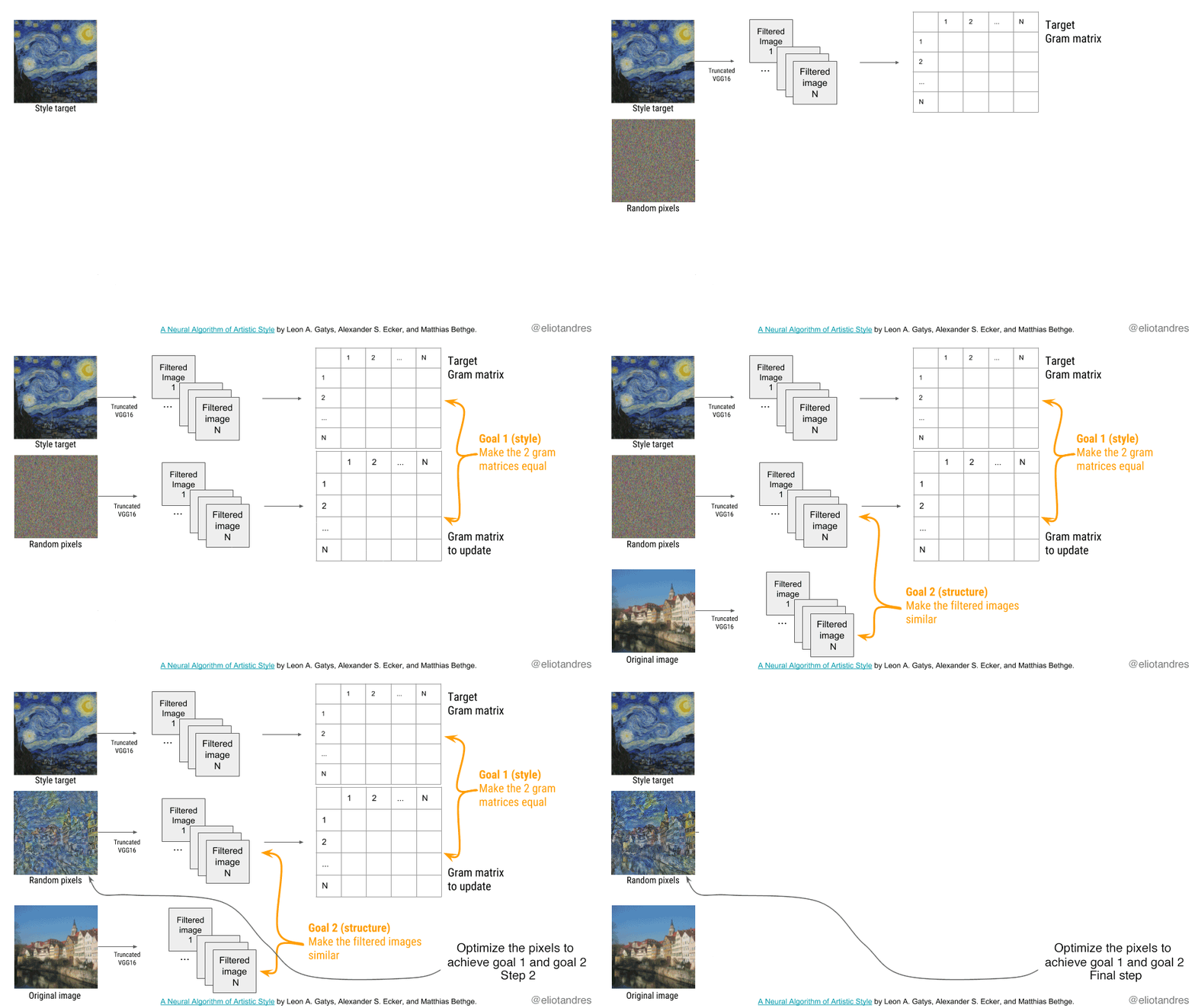
Although I tried to make the gif self-explanatory, here are a few more details:
- "Filtered image" means the output of a truncated VGG16 network. This means that we run the image through VGG16 but we stop at some layer. Depending on the goal, we stop at different layers.
- Gram matrix: you'll find an explanation below The general idea is that if coefficient (n1, n2) is high, it means that filters n1 and n2 activate for the same pixels.
- In practice there is a bit more than 5 steps to optimize the random pixels
The paper is really easy to read, I really recommend having a look
Bonus: how to calculate a Gram Matrix
(This explanation comes from Alexander Jung's summary of the paper)
- Take the activations of a layer. That layer will contain some convolution filters (e.g. 128), each one having its own activations.
- Convert each filter's activations to a (1-dimensional) vector.
- Pick all pairs of filters. Calculate the scalar product of both filter's vectors.
- Add the scalar product result as an entry to a matrix of size #filters x #filters (e.g. 128x128).
- Repeat that for every pair to get the Gram Matrix.
- The Gram Matrix roughly represents the texture of the image.
More ressources
Style transfer today
Since the original paper, style transfer improved a lot, both in speed and quality. Here's an example of what you can do with the latest paper:
Style transfer just reached a new wow moment ! Over the week-end I played with "Deep Painterly Harmonization", Fujun Luan et al. Can you tell the difference with a real painting ? Code: https://t.co/luFdB5F3M3 Paper (very well written): https://t.co/gSGoqZ2WEM pic.twitter.com/maRJRXpffK
— Eliot Andres (@EliotAndres) 16 avril 2018